Guitar and Sitar ( The Bridge )


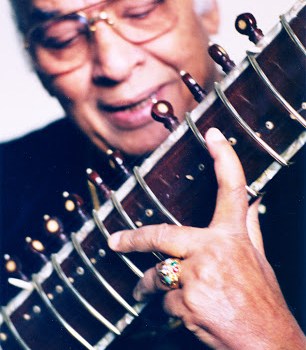
I am very happy to find this picture of Ustad Vilayat Khan Sahab capturing this trick. Notice that the index and the middle finger form a 90 degree angle. It is not possible to stretch the fingers this much in a flat position sideways. For example, this technique is used to play Sa with index (fixed), Re and Ga with […]
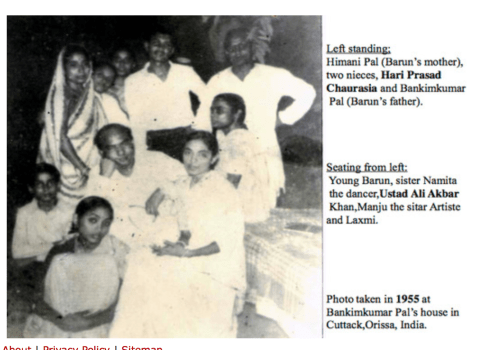
http://www.barunpalhansaveena.net/bio/a-rare-family/

http://wobeonfest.com
http://timesofindia.indiatimes.com/nri/citizen-journalists/citizen-journalists-reports/uttam-choudhary/India-fest-held-in-Milwaukee/articleshow/48555483.cms

It was amazing to find these rare records in Milwaukee among Richards Hayes’s personal collection of black records. My guruji, Pandit Kartick Kumar, was in the famous Black Horse record of George Harrison and Ravi Shankar. Here is some information about my guruji: George Harrison in Pictures Hindustan Times Music: Youtube video 1 Youtube video 2 –
Read the full article
Exploring and learning new Ragas is one of the primary joys of Indian Classical music apart from being a virtuoso. Playing a raga and playing an instrument are two different skills that we need to combine. The most common question I face while teaching is how to improvise in a raga within it’s structure. This is the most exciting part of our music. Two or more ragas may use the same note but sound a little different or totally different. I think one can not have a sound grasp of melodic patterns created in Raga without studying the different Angs (Bahar, Ahair, kadana, mallhar, Nat, Kalyan etc.) and also learning the groups (Sarang, Kanada, Mallhar, Nat, Kalyan etc.). The use of correct sruti and andolan is very important also to give life to a Raga thus to a performance. A Raga has its own enchanting power even when played in a simplified way. A raga should be analysed in the light of 10 elements (Trayadash lakhsan). It’s Jati, Arohan and Avarohan, Samay, Vadi and Samavadi, Nayas Swara, Pakad, Arohan or Avarohan gati (intention), vivadi Swara, Andolan at the correct note with specified suruti and it’s Utpatti or origin flavour of the parent Thaat. The spontaneity on Raga rendition comes from knowing it well. I recommend learning at least 50 basic Ragas, including all the ropes and tricks and then analytical listening.There used to be a music circle in Kolkata “SANGATIK” […]
 Indrajit Banerjee